MecaSequentialGappyBiaisMetaModel2
This use case aims to validate the methodology POD + ECM for quasistatic elastoviscoplastic computations with Z-set, with a reconstruction of the dual quantities using a meta model, see Section Publications, articles 1 and 8.
Optional prerequisite: Zmat.
The data needed to execute the tutorials below can be loaded here: exampleMecaSequentialGappyBiaisMetaModel2.zip
Features: replace the gappy-POD with a custom meta-model and correct the bias
The setting is very similar to tutorial MecaSequentialGappyBiaisMetaModel. We simply explain here how to specify a particular meta-model for the dual quantity reconstructor, instead of using the default one. This applies to methods without learning the errors between the HFM and the ROM, see tutorial MecaSequentialGappyMetaModel.
from Mordicus.BasicAlgorithms import ScikitLearnRegressor as SLR
from sklearn.gaussian_process.kernels import WhiteKernel, ConstantKernel, Matern

kernel = Matern(length_scale=1., nu=2.5) + ConstantKernel(constant_value=1.0, constant_value_bounds=(1.e-12, 1.e12)) * \
    WhiteKernel(noise_level=1, noise_level_bounds=(1e-12, 1e12))
regressor = SLR.MyGPR(kernel=kernel)
paramGrid = {'kernel__k1__length_scale': [1., 2.], 'kernel__k1__nu':[1.5, 2.5], 'kernel__k2__k1__constant_value':[1.], \
    'kernel__k2__k2__noise_level':[1]}

dualReconstructionData = Mechanical.LearnDualReconstruction(collectionProblemData, \
    dualNames, reducedIntegrationPoints, methodDualReconstruction = "MetaModel", \
    timeSequenceForDualReconstruction = timeSequence, \
    snapshotsAtReducedIntegrationPoints = onlineDualQuantityAtReducedIntegrationPoints, \
    regressor = regressor, paramGrid = paramGrid)
The last two attributes of dualReconstructionData enable to specify any scikit-learn meta-model.
Results
In Fig. 14, the quality of the reduced model is illustrated by comparing it to the high-fidelity reference.
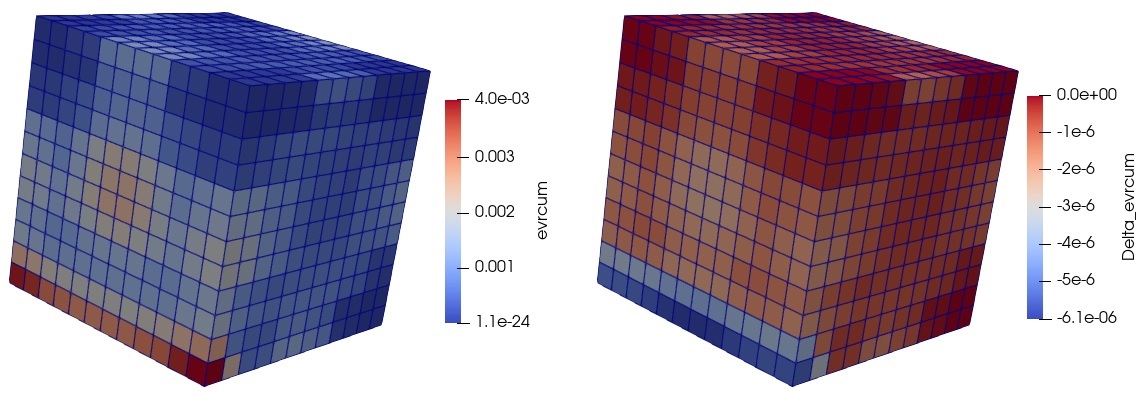
Fig. 14 Illustration of the ROM accuracy on the accumulated plasticity p (left) HFM, (right) pointwise difference between the ROM and the HFM.
We notice that with a more involved meta-model, the accuracy is much better than tutorials MecaSequentialGappyMetaModel and MecaSequentialGappyBiaisMetaModel.